in case of emergency DO NOT break the glass
Interview with PICA (Maile Bowen, Public Program & Studio Manager):
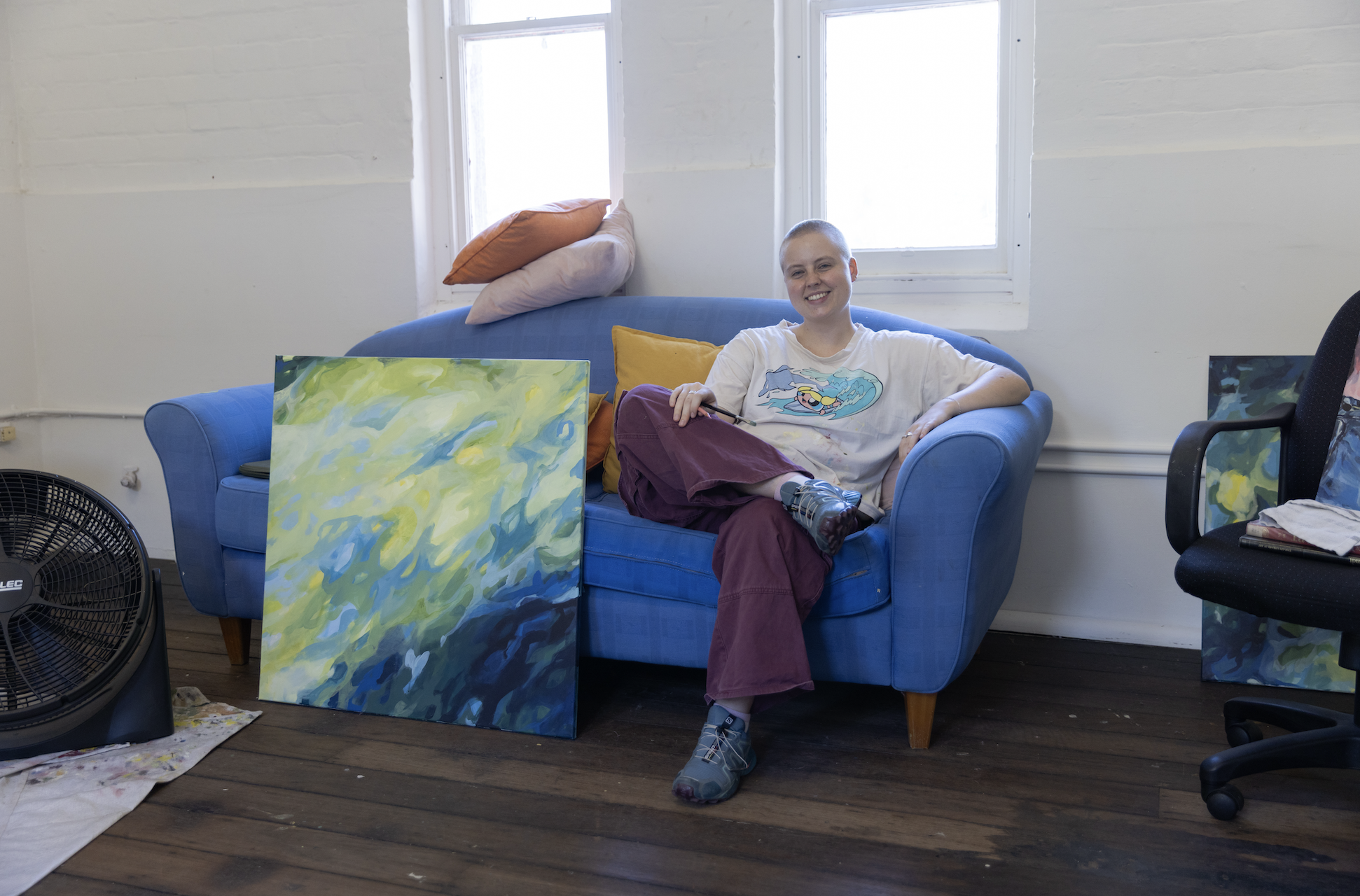
image: Liam Ayres
You’re currently undertaking a residency at PICA. Could you tell us about the project you’re developing during your time here?
Yes! The developing body of work takes the form of a storyboard, flitting between screen-printed text and painted images. Expanding on suggestions already present in government adaptation planning, the work imagines a scenario where the ocean has become too hot for fish populations, so for preservation purposes, a rollout is enforced. The work follows the trials and tribulations of a fish and his designated adult, focusing on a therapy session where he describes his ongoing nightmares and is prescribed breathing exercises.
Your work examines and explores a frustration with our governments policies and projections towards Climate Change and our future. I am wondering when you started to think about this, was there a particular experience or moment in your life that led you to want to make work about this topic?
Terms like ‘climate anxiety’ are often employed by the media to account for the rising number of people, particularly young people, who are fearful about the future, or whose daily functioning is negatively impacted by their feelings about climate change (45% of young people suggested Dr Chloe Watfern in 2022). Such framing pathologizes; it declares the supposedly afflicted individual’s response abnormal and disproportionate. This is not the case. Climate-related distress is caused by a very real threat. A threat that can be significantly reduced if coordinated action is taken.
Individual actions matter. Using the right bins, avoiding single-use plastics, being mindful of what we consume, opting out of fast fashion… They are important steps (although, of course, all mediated by access). But individuals must participate in wider systems to meet their basic needs. We pay taxes knowing that $16.3 billion per year goes towards subsidising fossil fuels (Australia Institute, 2026), purchase essential groceries – like (alt or cow) milk – in cartons lined with materials that make them unrecyclable, and turn on lights using electricity that is far from being supplied by the promised 82% renewables. In this space between action and controllable outcome, agency is compromised.
Studying climate-related distress in 10,000 participants aged 16-25, Caroline Hickman and her team identified that distress was consistently “…associated with beliefs about inadequate governmental response and feelings of betrayal.” Government reporting seems to validate such thinking with offerings like: “This risk is expected to increase to Very High by 2050 as there is a significant risk of inaction and adaptive inertia in governance structures.” (“Australia’s National Climate Risk Assessment,” page 231).
These disjointed conditions encourage hopelessness and apathy. The body of work bites back accordingly, drawing attention to government strategies and environmental policies that are negligent, misdirected, and disappointing.
IN CASE OF EMERGENCY DO NOT BREAK GLASS has an element of playfulness to it, drawing on speculative imagining— why was this important to you to make work around climate change in this way?
I think playfulness is a way to engage with a situation bleak enough to make one utterly nihilistic, and we need to engage. We need to find ways to be angry, to care, to listen, to unlearn, to collaborate, none of which can be sustained when overcome with despair.
Speculative imagining feels particularly appropriate where climate action, or inaction, is concerned. Because we enable futures in the present, it is useful to consider what kinds of futures we are working towards (including in passivity). This is not to undermine the impacts of climate change already felt widely (and disproportionately shouldered by those least supported), but rather to emphasise malleability.
Also, the most recent round of climate reports (2025’s “Australia’s National Climate Risk Assessment,” “Annual Climate Change Statement,” “Australia’s Emission Projections,” “Annual Progress Report,” “Australia’s Net Zero Plan,” and “Carbon Leakage Review,” all of which would benefit from a scathing literary review – plot holes abound!) made it apparent that many politicians and legislators have a limited capacity to imagine the actualisation or consequences of their speculative suggestions. This project may serve as a resource in assisting them to address that deficit.
Where did the idea of assigning each person a fish come from? Was there a specific policy or mindset you were responding to?
Yes! It responds to a strategy suggested in the ‘Natural Environment’ chapter of “Australia’s National Adaptation Plan” (2025), which proposes moving species from environments that climate change is expected to make hostile or uninhabitable into alternative, ‘more suitable’ ones;
Where environmental conditions become increasingly challenging for resilience and persistence…translocating sensitive species and populations into more suitable locations outside their historic range, will be required. (page 38)
Needless to say, this ‘solution’ – presented under the subheading, “Future Priorities” – neglects the source of the problem. It is also incredibly impractical, if not impossible. If temperatures, severe weather events, and water scarcity follow the trajectories mapped within the same report, finding these alternative environments may prove… difficult.
Fish seemed a useful way to illustrate the impracticality of this proposal (and others like it), given that there are limited places one can put hordes of deported marine creatures.
images coming soon, for the meantime see instagram @wolf_vanheerden